
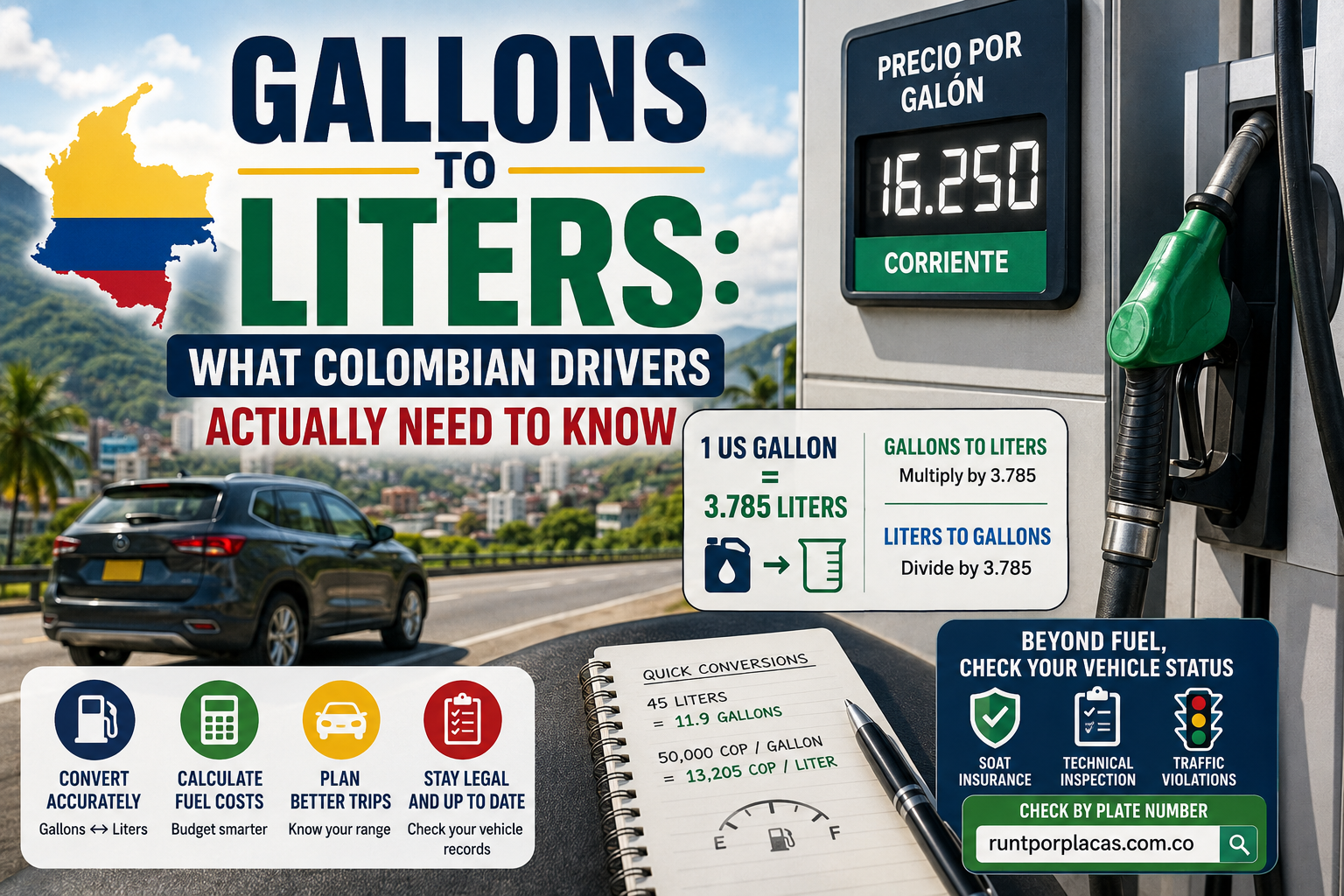
Colombia is one of the last places in Latin America where gallons still show up at the pump, which trips up plenty of drivers who grew up thinking in liters — or vice versa for anyone new to the country. Getting the conversion right matters more than it seems, because fuel budgeting, trip planning, and even comparing prices across stations all depend on reading the numbers correctly. This guide breaks down the conversion itself, then covers the other side of vehicle ownership in Colombia that trips people up just as often.
Why Colombia Still Uses Gallons for Fuel
Most of the world standardized on liters, but Colombia, along with a handful of other countries, kept the gallon for fuel pricing specifically. That means pump prices are quoted per gallon (US gallon, not Imperial), while nearly everything else in daily life — cooking, plumbing, industrial measurement — runs on the metric system.
The mismatch is exactly why gallon-to-liter confusion is so common here: Colombians grow up metric, then hit the one major exception at the gas station.
The Core Conversion
One US gallon equals 3.785 liters. That single number covers almost every fuel calculation you’ll need:
- To convert gallons to liters: multiply by 3.785
- To convert liters to gallons: divide by 3.785
For quick mental math, rounding to 3.8 is close enough for everyday budgeting, though exact figures matter more for larger purchases or fleet calculations.
Applying the Conversion to Real Fuel Costs
Say a station lists a price per gallon and you want to know the cost per liter, or your tank capacity is listed in liters but the pump charges by the gallon. Here’s the practical math:
Price per liter = price per gallon ÷ 3.785
Tank capacity in gallons = tank capacity in liters ÷ 3.785
If your car’s manual lists a 45-liter tank, that’s roughly 11.9 gallons — useful to know when budgeting a full fill-up against the posted price per gallon.
Beyond Fuel: What Else Colombian Vehicle Owners Should Track
Fuel math is only one piece of running a vehicle in Colombia. The country centralizes vehicle information — ownership, SOAT insurance status, technical-mechanical inspection validity, and traffic violations — in a national registry. Checking your vehicle’s standing there is just as routine as watching fuel prices, and a lookup tool at https://runtporplacas.com.co/ lets you check that record by plate number in a couple of minutes. Drivers who stay on top of both — what they’re paying at the pump and what their registry status shows — avoid the two most common surprises in vehicle ownership here: an unexpected fuel bill and an expired document you didn’t know had lapsed.
A Simple Routine for Colombian Drivers
- Know your car’s tank size in both units. Convert it once and keep the number handy so every fill-up calculation is instant.
- Check the price per liter before comparing stations. Posted prices per gallon can look similar while hiding a real difference once converted.
- Review your vehicle’s registry status periodically. SOAT and technical inspection both expire, and driving with either lapsed carries real penalties.
- Budget fuel costs monthly, not per trip. Converting and tracking consistently gives you a clearer picture than one-off calculations.
- Keep both numbers — liters and gallons — in your notes. You’ll need to think in gallons at the pump and liters almost everywhere else.
Common Conversion Mistakes to Avoid
Confusing US and Imperial gallons. Colombia uses the US gallon (3.785 liters), not the Imperial gallon (4.546 liters) used in the UK — mixing them up throws off every calculation.
Rounding too early in multi-step math. Round only your final answer, not the conversion factor itself, especially for larger fuel purchases.
Forgetting the conversion runs both directions. A tank capacity in liters and a price in gallons need to meet in the same unit before you can compare anything meaningfully.
Assuming all pumps display the same unit. Always confirm what unit a station is quoting before doing the math, especially near borders or at unfamiliar stations.
FAQs
How many liters are in a gallon of gas in Colombia? Colombia uses the US gallon, which equals 3.785 liters.
Why does Colombia price fuel in gallons instead of liters? It’s a historical holdover — Colombia is metric for nearly everything else but kept gallon-based fuel pricing, along with a few other Latin American countries.
How do I calculate my cost per liter from a price per gallon? Divide the price per gallon by 3.785 to get the equivalent price per liter.
What else should Colombian drivers check besides fuel prices? Vehicle registration status, SOAT insurance validity, and technical-mechanical inspection dates, all trackable through the national vehicle registry.
Is the gallon-to-liter conversion the same everywhere? Only if everyone’s using the same gallon type. Always confirm US versus Imperial gallons before converting, since they differ by nearly 20%.
Final Thoughts
Getting gallons and liters right keeps your fuel budget accurate, and keeping an eye on your vehicle’s registry status keeps you legal on the road. Both are five-minute checks that save real money and hassle down the line — worth building into a routine rather than remembering only when something’s already overdue.