
Introduction
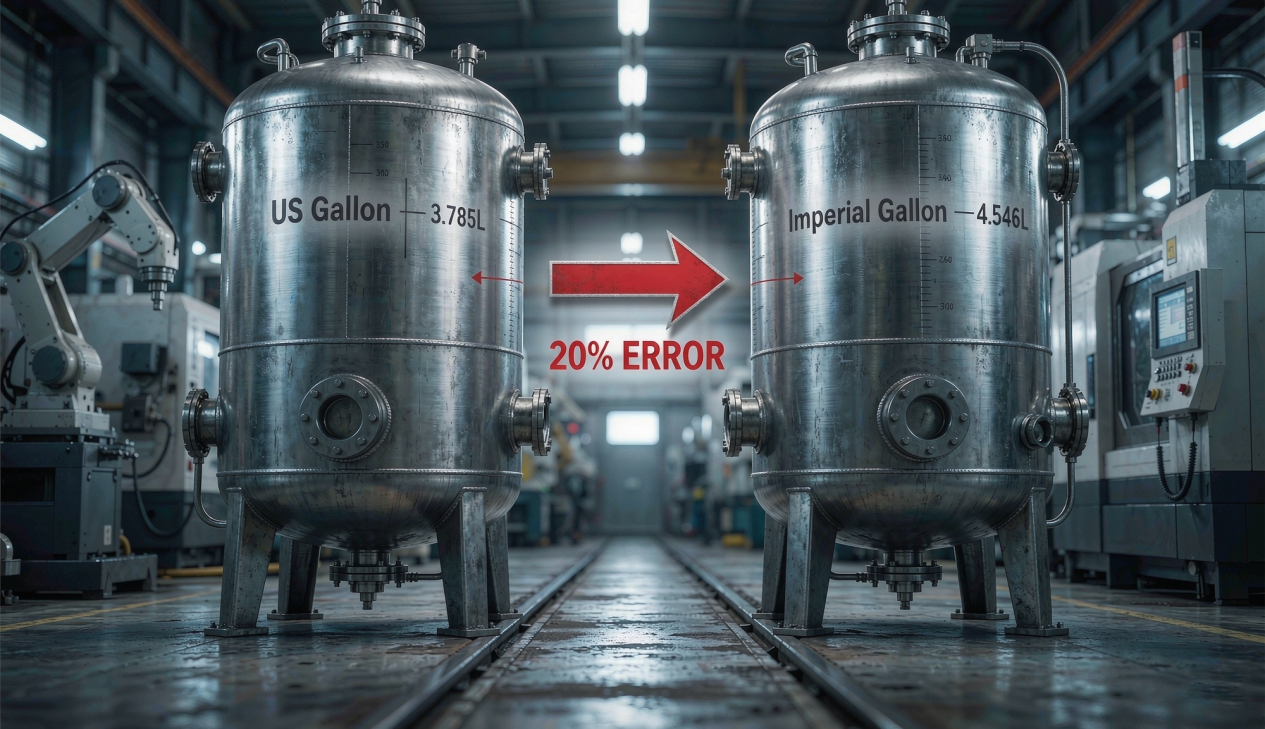
Taking volume errors out of industrial storage tanks involves identifying the US and imperial gallon conversions and matching the theoretical capacity with wall thickness tolerances during prototype design. The confusion of US liquid gallon (3.78541 liters) with imperial gallon (4.54609 liters) difference of 20% leads to interference and seal failure. We use our article for showing the combination of conversion logic with CNC machining as a full package from parameter change to low-cost prototype delivery.
Why Do Volume Conversion Errors Cause Severe Assembly Failures in Fluid Handling Equipment?
Many units for liquid are in conflict: American drawings are in gallons while European systems are in liters. In fact, a 20% wrong estimate of the size of the chamber could result in the misalignment of the ports by several millimeters.
Major things:
- Use accurate conversion from galones a litros: gallons (US) ×3.78541 = liters; gallons (imperial) × 4.54609 = liters.
- Make sure that the capacidad en litros de tanques industriales matches the dimensions before production.
- Use wall thickness and internal devices in the calculation of the capacity.
How Can Tolerances Be Maintained in Machining 10 to 100 Fluid Chamber Parts?
Aluminum and stainless steel valve bodies are susceptible to thermal deformation while doing small-batch prototyping of valve body.
Thermal and Stress Challenges
Thin chamber walls can easily get damaged. Dimensional variation happens because the heat is not dissipated evenly during run of 10 to 100 parts only. Stress relief annealing in between coarse machining and fine machining is a good remedy to that.
Multi-Axis Machining for Precision
The machine tool has to keep within a tolerance of deep cavity part on multi-axis machine to an ISO 9001 standard. Holding the part in a one fixture system gives a coaxial hole of bore within ±0.01 mm.
Choosing suitable process steps does away with the need of molds and still one can validate the strength of 55 galones a litros components. Engineering teams that want to know how low volume CNC machining can get 3–5 days lead times on 10–100 part runs have to understand what kind of stocked standard components and automated DFM contribute toward an optimal balance of cost against precision.
What Key Factors Dictate Rapid Turnaround Times for Custom Industrial Tanks?
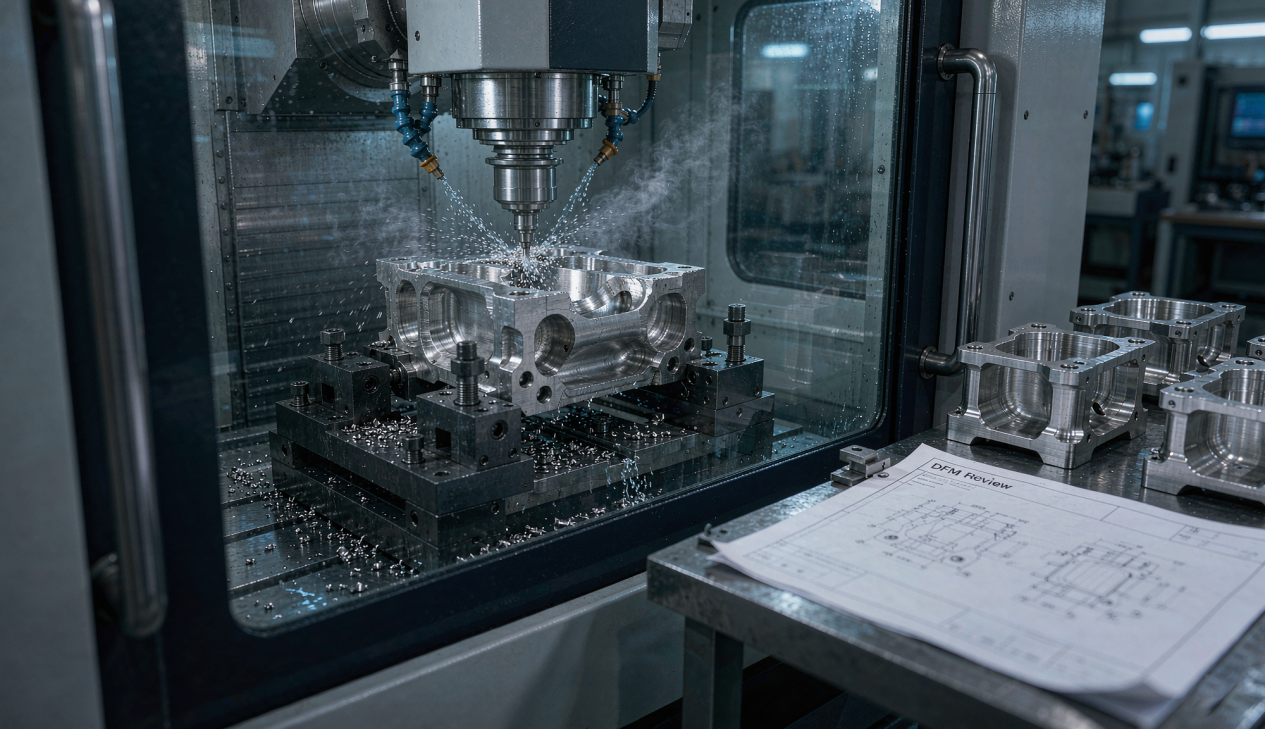
Figure 2: Low-volume CNC machining trials combined with rapid DFM review ensure precision and speed for custom fluid components.
Rush time is influenced by raw material pre-treatment, setup of jigs and tools, and 5-axis programming. Today’s machine shops apply IATF 16949 standards to accelerate prototyping.
Essential factors for rapid CNC lead time service:
- Materials pre-treatment: alloys that come pre-stocked (6061-T6, 304) do not cause delays.
- Quick-change jigs: the use of modular vices reduces setup time to under 30 minutes.
- 5-axis programming: CAM templates reduce programming time by 40%.
Companies like LS Manufacturing that are quick on their feet have a standard tool library as well as a fast DFM review process. By the means of such these precision low volume CNC machined parts, prototyping of a 55 galones a litros fuel tank takes about 5–7 days maximum for delivery.
How Should Engineers Evaluate Machining Cost-Efficiency Across Different Production Batches?
The cost per part differs across prototype, small-batch, and mass production phases.
Influential parameters of low volume CNC machining cost:
- Machineability of materials: 6061aluminum cuts 3× faster than the 304 stainless.
- Design intricacy: Deep chambers extend the machine time by 15–25%.
- Surface finishing: Anodizing can bring the per piece cost increase to around 15–30.
For identifying an efficient low volume CNC manufacturer the best thing is to go for the same kind of chamfer and thread specs. For an exact custom CNC machining quote you can send the grade of materials, finish specifications, and pressure test parameters if any.
Why Do Multi-Tier Quality Management Certifications Ensure Reliable Fluid Hardware?
AS9100D mandates full traceability; ISO 14001 ensures green cutting.
Closed-Loop Quality Control
Incoming material spectrometer verification, CMM scanning while machining, and pneumatic pressure testing check if seal integrity is intact.
Certification Integration
- Raw material: Spectrometer analysis following AS9100D.
- In-process: CMM at ±0.002 mm.
- Final test: Leak testing at 1.5× working pressure.
Working with certified CNC machining services partners makes sure that low volume CNC machining service brings forth fluid components that are up to the most stringent industry standards.
Conclusion
Reliable fluid systems originate from thorough unit conversion and accurate machining. If the team needs to change gallons to liters or handle seal tolerances, it is important for them to remove all error sources at the initial level. Besides that, flexible machining with small lot sizes can be a great tool for quick validation. Get in touch with LS Manufacturing’s engineering dept. To send your 3D models for a detailed DFM analysis and a tailored proposal.
FAQs
What is the fundamental difference between US liquid gallons and imperial gallons in fluid tank design?
US liquid gallons measure about 3.785 liters, and imperial gallons measure up to 4.546 liters, that is a volume difference of nearly 20%. Mistaking the units in fluid chamber modeling would result in huge differences between the real tanks capacity and the design figures.
Why is low-volume CNC machining recommended before creating dedicated tooling for fluid tanks?
CNC machining trials involve neither expensive molds nor any waiting time. They can supply a working part made of real steel within only several days and allow checking seal tolerances and pressure performance.
How can sealing integrity be maintained across precision low-volume fluid components?
Determine mating surface tolerances by metric standards recalculations; limit mating surface roughness within suitable micron range; also make 100% examination with CMM and pneumatic pressure testing.
Which design variables most heavily impact custom fluid component machining costs?
The material type’s difficulty to machine, clamping intricacy for deep cavities, tolerance class, and the need for anti-corrosive finishes like anodizing or electroless nickel plating are the main factors deciding the cost.
What role do ISO and aerospace quality certifications play in fluid component manufacturing?
Full certification systems guarantee traceability from the original material analysis, multi-axis cutting detection to final non destructive test avoiding internal porosity and micro-cracks, that could bring leakage.
About the Author
Senior mechanical manufacturing engineer with over a decade of experience in industrial fluid hardware design and precision CNC machining, specializing in metric-imperial cross-border engineering standard alignment, small-batch agile manufacturing process optimization, and quality management system implementation.