
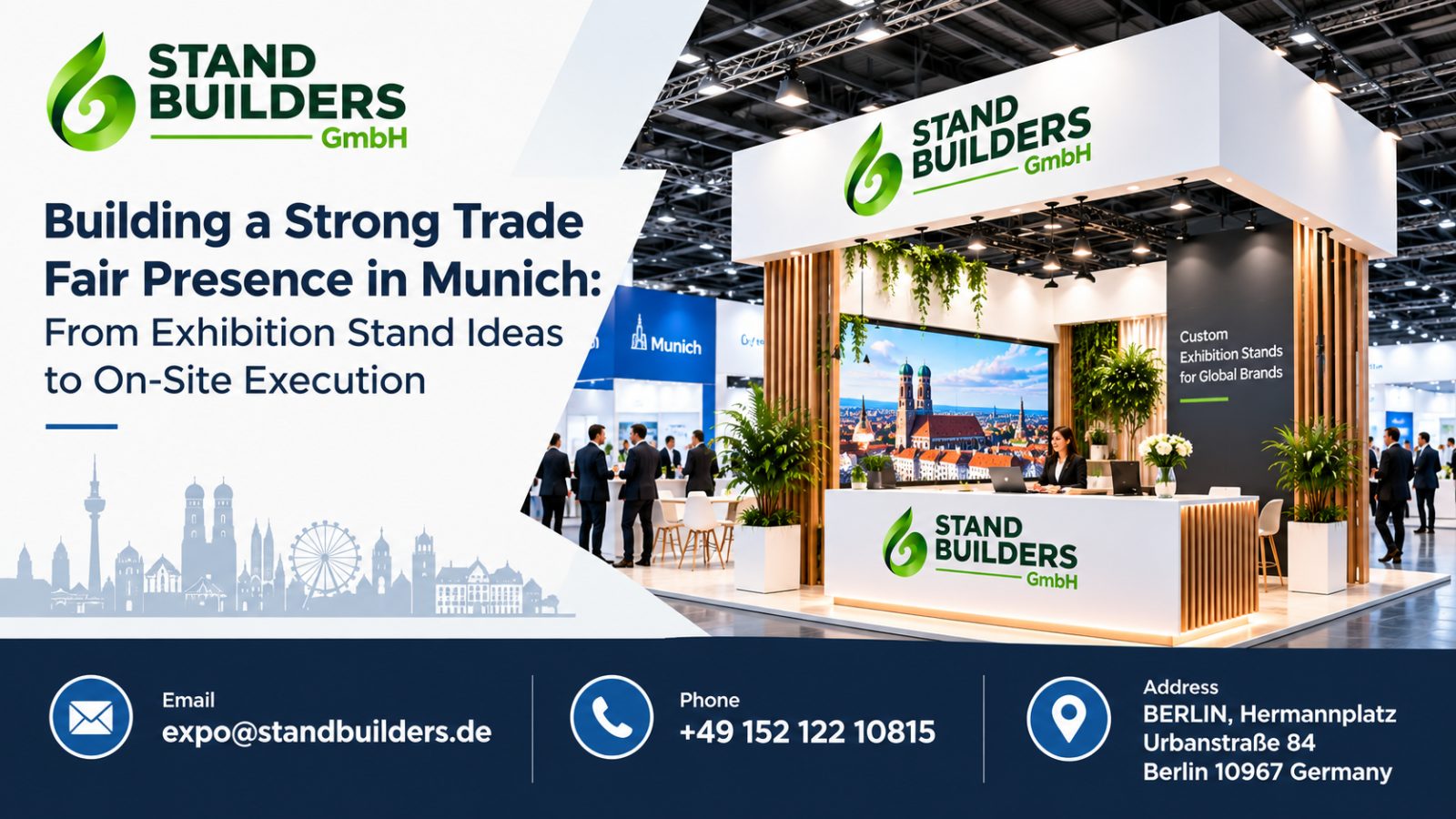
Munich is an important destination for international trade fairs, bringing together businesses from industries such as construction, technology, transport, environmental solutions, and manufacturing. For exhibitors, these events offer valuable opportunities to introduce products, meet potential buyers, and develop professional relationships. However, creating an effective exhibition presence requires more than an attractive display. Working with an experienced exhibition stand design company in Munich can help businesses coordinate design, construction, and installation requirements. Similarly, choosing a reliable exhibition booth builder in Germany allows exhibitors to approach complex projects with a clearer plan. Stand Builders GmbH provides customised exhibition stand solutions, combining creative design, production, logistics, and on-site support for trade fairs in Munich and other European locations.
Munich’s Trade Fair Environment: What Exhibitors Should Understand
Munich hosts exhibitions that attract professionals, manufacturers, suppliers, and decision-makers from international markets. Events such as BAU, transport logistic, IFAT, and electronica serve different industries, but they share one important characteristic: exhibitors compete for visitors’ attention within a limited space and timeframe.
A company’s exhibition stand should therefore communicate its purpose quickly while providing enough room for meaningful interactions.
For example, a manufacturer displaying industrial equipment may require accessible demonstration areas, while a technology business might prioritise digital presentations and meeting spaces.
Understanding the event’s audience is an important starting point. Before choosing a booth design, exhibitors should identify the visitors they want to reach and the information those visitors are likely to need.
The exhibition venue’s technical regulations, stand dimensions, installation schedule, and available facilities must also be considered before finalising the design.
The Connection Between Exhibition Stand Design and Business Objectives
A successful exhibition stand should support a company’s marketing goals rather than simply provide an attractive structure.
Some exhibitors attend trade fairs to launch products, while others focus on generating sales enquiries, meeting distributors, or strengthening relationships with existing customers.
These objectives influence the design process.
Creating an Immediate Brand Impression
Visitors should be able to recognise the company and understand its main offering without reading lengthy descriptions.
Clear branding, carefully positioned graphics, suitable lighting, and concise messaging can help communicate the company’s identity.
The goal is not to fill every surface with promotional information. Instead, the stand should present a focused message that visitors can understand quickly.
Designing Spaces for Visitor Interaction
An exhibition booth builder in Germany must accommodate different types of conversations.
Open display areas can encourage visitors to explore products, while meeting spaces provide a quieter environment for detailed discussions.
Reception counters, demonstration areas, and furniture should be positioned to support natural movement through the stand.
A practical layout makes the exhibition experience more comfortable for visitors and staff.
Which Exhibition Stand Format Works Best in Munich?
Businesses participating in Munich trade fairs can choose from several exhibition stand formats. Each provides different advantages depending on the available space, budget, and presentation requirements.
Stand Builders GmbH offers custom, modular, double-decker, and country pavilion exhibition stands.
| Stand Format | Main Characteristics | Suitable Applications |
| Custom Exhibition Stand | Individually designed layouts, materials, and branding | Product launches and distinctive brand presentations |
| Modular Exhibition Stand | Reusable components with flexible configurations | Companies attending multiple exhibitions |
| Double-Decker Stand | Two-level structure with additional functional space | Large booths requiring private meeting areas |
| Country Pavilion Stand | Coordinated exhibition space for several exhibitors | Trade associations and international group participation |
Custom Exhibition Stands for Individual Presentations
Custom stands are developed around a company’s specific requirements.
They can include tailored product displays, branded reception counters, demonstration areas, and meeting rooms.
This approach is useful when standard layouts cannot accommodate the exhibitor’s products or desired visitor experience.
Modular Exhibition Stands for Repeated Participation
Modular stands use components that can be assembled into different configurations.
Businesses attending several exhibitions can adapt these structures to changing floor plans while maintaining consistent branding.
Reusable components may also reduce the need for repeated manufacturing when they remain suitable for future events.
Double-Decker and Country Pavilion Solutions
Double-decker stands provide an additional upper level that can accommodate meetings or hospitality activities.
However, their construction requires engineering considerations and approval from the exhibition organiser.
Country pavilions serve organisations representing multiple businesses. A coordinated design brings exhibitors together while allowing individual companies to maintain their identities.
How Stand Builders GmbH Supports Exhibition Projects in Munich
Stand Builders GmbH offers exhibition stand design and construction services covering the main stages of an exhibition project.
Its Munich service page describes an approach that combines consultation, creative development, construction, logistics, and project management.
Consultation and Design Planning
The process begins with understanding the exhibitor’s goals, brand identity, budget, and available floor space.
Designers consider how products will be displayed, how visitors will move through the stand, and which functional areas are required.
3D Design and Visualisation
Three-dimensional concepts allow exhibitors to review their proposed stand before manufacturing begins.
These visualisations show the arrangement of structural elements, graphics, lighting, furniture, and product displays.
Clients can provide feedback and request revisions before approving the design.
Manufacturing and Material Selection
Once the design is approved, the production team prepares the required components.
Stand Builders GmbH describes its in-house production capabilities as part of its wider exhibition construction services.
Material selection considers appearance, functionality, durability, and project requirements.
Logistics, Installation, and On-Site Management
Completed components are packaged and transported to the exhibition venue.
Installation teams assemble the stand according to the approved design and relevant technical requirements.
On-site project management supports coordination during the build-up period and helps address practical installation concerns.
After the exhibition, dismantling and storage services can support the handling of reusable components.
Why Sustainable Exhibition Stand Planning Matters
Sustainability has become an important consideration in exhibition design and construction.
Temporary structures can involve significant material use, packaging, transportation, and waste. Exhibitors can reduce unnecessary resource consumption by considering reuse and efficient construction during the planning stage.
Stand Builders GmbH highlights sustainable materials and reusable exhibition structures on its Munich service page.
Modular stands are particularly relevant because their components can be adapted for multiple events.
Other practical considerations include selecting durable materials, reducing unnecessary packaging, planning transportation efficiently, and storing suitable components for future use.
However, sustainability should be assessed across the complete project. A reusable stand still involves transportation, maintenance, and storage, so its environmental benefits depend on how frequently and efficiently it is used.
What Should Exhibitors Prepare Before Requesting a Stand Design?
A detailed project brief helps the design and construction team understand what is required.
Exhibitors should prepare the following information:
- Exhibition details: Event name, venue, dates, hall, and booth number.
- Floor plan: Stand dimensions, available entrances, and relevant venue restrictions.
- Branding materials: Company logo, colour guidelines, graphics, and design references.
- Display requirements: Products, demonstration equipment, screens, and furniture.
- Functional spaces: Reception counters, storage, meeting rooms, and hospitality areas.
- Budget: An estimated spending range covering the required services.
- Technical documentation: Construction rules and requirements supplied by the organiser.
Providing these details early helps reduce misunderstandings and allows designers to develop a more practical proposal.
Common Planning Mistakes That Can Affect Exhibition Results
Even experienced exhibitors can encounter difficulties when important decisions are delayed.
One common mistake is focusing heavily on appearance while overlooking functionality. A visually impressive stand may still perform poorly if visitors cannot move comfortably or access product displays.
Another challenge is underestimating the time required for approvals and manufacturing.
Complex custom structures and double-decker stands may need additional technical documentation, making early preparation particularly important.
Budget planning can also create problems when exhibitors consider only the initial construction price.
Transportation, installation, graphics, venue services, and dismantling should be included when evaluating overall project costs.
Clear communication between the exhibitor, design team, and project manager helps reduce these risks.
Making Better Use of the Exhibition Stand During the Event
Once the stand is installed, its effectiveness depends on how the exhibition team uses the space.
Staff should understand the company’s objectives, key products, and intended audience.
Demonstration areas should remain organised, promotional materials should be accessible, and meeting spaces should be available when required.
Rather than approaching every visitor with the same sales message, staff can ask questions to understand individual interests.
Collecting relevant enquiries and recording agreed follow-up actions can help turn exhibition conversations into future business opportunities.
After the event, exhibitors should review whether the stand supported their objectives and identify improvements for future participation.
Conclusion
Creating an effective exhibition stand in Munich involves combining creative design with practical planning, technical knowledge, and reliable project coordination.
Businesses should begin by defining their objectives, understanding their target audience, and selecting a stand format suited to their exhibition requirements.
Custom stands provide flexibility for individual presentations, modular structures support repeated use, double-decker stands offer additional functional space, and country pavilions accommodate group participation.
Stand Builders GmbH provides exhibition stand design and construction services for businesses participating in Munich trade fairs. Its work covers consultation, 3D design, production, graphics, logistics, installation, on-site project management, dismantling, and storage.
By preparing detailed requirements, reviewing technical regulations, and considering the complete exhibition lifecycle, businesses can develop professional exhibition spaces that support visitor engagement, brand communication, and long-term marketing objectives.