
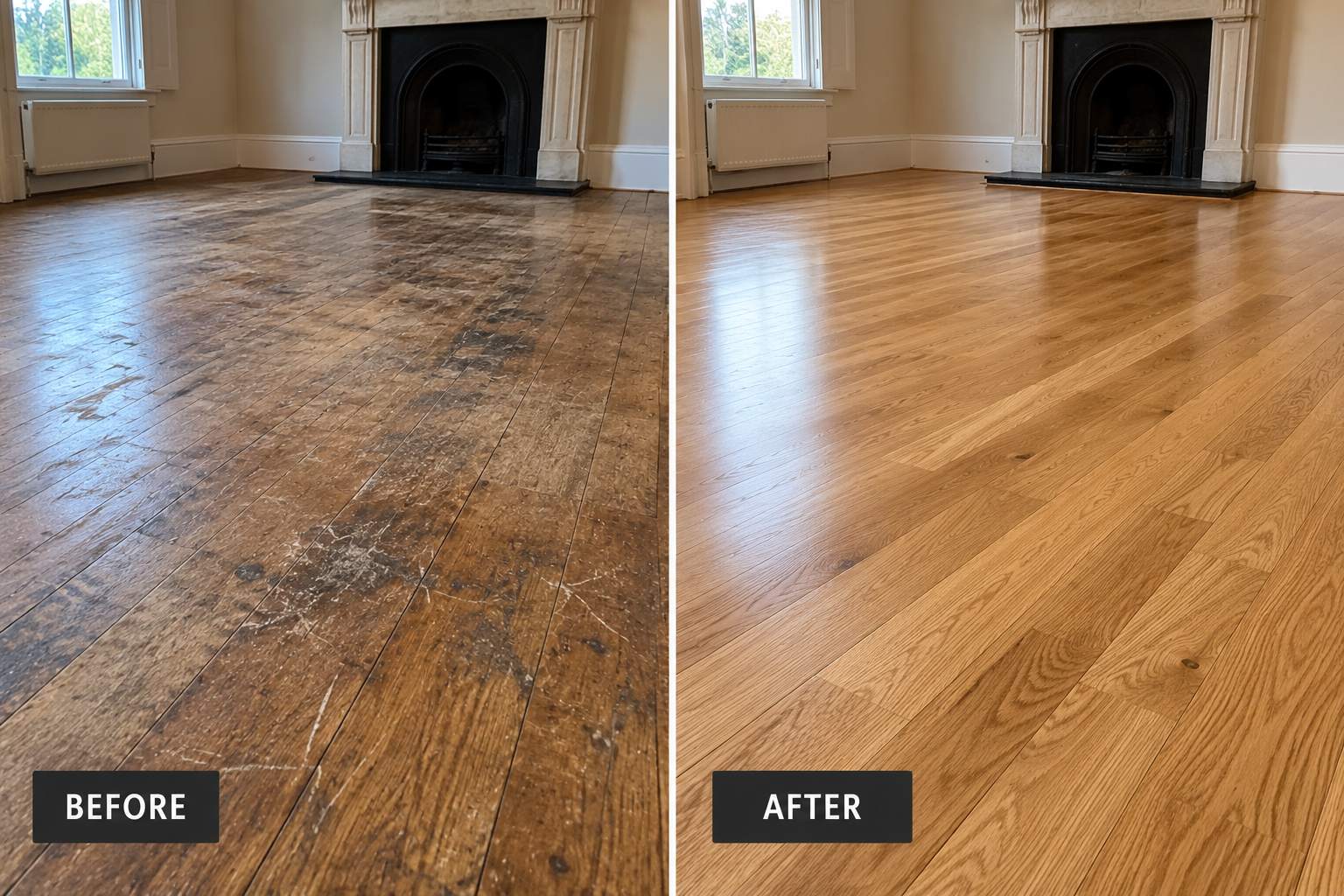
Have your floors sanded and restored with the most advanced Dustless Floor Sanding technology ever
Why Restoring Old Wooden Floors Is Better Than Replacing Them
Wooden floors are one of those features that can completely change the appearance of a property. A beautiful oak, pine, beech or other hardwood floor can add warmth and character to a home while providing a highly durable surface capable of lasting for decades. The problem is that wooden floors do not stay perfect forever. Scratches appear, furniture leaves marks, high traffic areas become dull and years of cleaning can gradually affect the original finish.
Eventually, many property owners reach the same conclusion: the floor looks old, so perhaps it needs to be replaced. But does it? In many cases, replacing an old wooden floor is completely unnecessary. Underneath the scratches, worn lacquer, stains and discolouration there can still be perfectly usable timber. Professional floor sanding can remove the damaged surface and expose fresh wood underneath. Repairs can then be completed where necessary before a new protective finish is applied.
The result can be a floor that looks completely different without removing and disposing of the original timber. From an environmental perspective, this makes a lot of sense.
A Wooden Floor Can Have an Exceptionally Long Life
One of the greatest advantages of a real wooden floor is its potential lifespan. Unlike many modern floor coverings that eventually have to be completely replaced, a good quality wooden floor can often be restored several times during its life. A solid hardwood floor is particularly suitable for restoration because there is a substantial amount of real timber available. Depending on the thickness and condition of the boards, the surface can potentially be professionally sanded several times.
Engineered wooden floors can also often be restored, although this depends on the thickness of the real wood wear layer. This ability to renovate rather than replace is extremely important. A floor does not necessarily reach the end of its useful life simply because the surface has become scratched or unattractive. Very often it is only the finish and the uppermost layer of timber that have deteriorated. Floor sanding removes this damaged layer and exposes clean wood underneath.
Restoration Means Less Waste
Think about what happens when an old floor is replaced. The existing flooring has to be lifted, trims may need to be removed and the unwanted flooring has to be loaded into a vehicle, transported away and eventually processed or disposed of. New flooring then needs to be manufactured, packaged, transported, delivered and installed.
Compare this with restoration. The existing floor stays exactly where it is. Instead of removing hundreds of kilograms of flooring material from a property, only a relatively small amount of wood is removed from the surface during sanding. Any damaged individual boards can potentially be repaired or replaced without removing the entire floor. If something can be successfully repaired and reused, there is often little reason to throw it away.
Less Demand for New Materials
Every new wooden floor requires raw materials. Trees have to be grown and harvested before the timber can be transported, processed, dried, graded and manufactured into flooring. Additional resources are required for packaging, storage, transportation and installation.
Responsible forestry can provide a renewable supply of timber, but extending the useful life of materials that have already been produced remains an important part of reducing unnecessary consumption. Imagine a wooden floor that has already been installed in a house for twenty years. If that floor can be professionally restored and used for another ten, fifteen or twenty years, the existing material continues providing value without immediately requiring a replacement floor.
Old Does Not Necessarily Mean Damaged
One of the biggest mistakes people make with wooden floors is assuming that an unattractive surface means the actual floor is damaged beyond repair. This is frequently not the case. A floor can look terrible while still being structurally sound. Old lacquer can become scratched and dull, areas around doors can become heavily worn, furniture can leave marks and UV exposure can create noticeable colour differences.
Many of these problems can be addressed during professional floor restoration. The floor can be sanded back to clean timber before repairs and gap filling are carried out where appropriate. The owner can then decide how the restored floor should look. It can retain a natural appearance or potentially be stained to create an entirely different colour. A floor that was previously dark, yellow or heavily marked can therefore look dramatically different after restoration.
Modern Floor Sanding Produces Much Less Dust
Older floor sanding equipment had a reputation for creating enormous amounts of dust. Anyone who remembers traditional sanding may remember clouds of fine wood dust spreading throughout the property. Professional equipment has changed considerably. Modern floor sanding machines can be connected to powerful dust extraction systems that collect much of the dust as it is generated.
Professional belt sanders, edge sanders and extraction equipment make the process considerably cleaner than traditional sanding methods. Dust cannot be completely eliminated from every stage of a restoration project, but modern dust controlled sanding systems can significantly reduce the amount released into the surrounding property. This makes floor restoration much more practical for occupied homes, offices, shops and other buildings.
Water Based Floor Lacquers Have Changed the Industry
Floor finishes have also developed considerably. Traditional solvent based products could produce strong smells and contain substantial levels of volatile organic compounds. Modern professional water based floor lacquers provide another option. High quality water based polyurethane finishes can provide excellent resistance to everyday wear while producing considerably less odour than many traditional solvent based products.
These lacquers are available in different appearances, including ultra matt, matt, satin and higher sheen finishes. Some modern lacquers are so natural looking that it can be difficult to tell that the wood has been lacquered at all. This allows property owners to maintain the natural appearance of timber while still protecting the surface against everyday traffic.
Floor Sanding Can Completely Change a Room
Environmental considerations are important, but restoration also needs to make financial and practical sense. Fortunately, floor sanding can produce a dramatic visual improvement. When an old coating and surface damage are removed, the natural colour and grain of the timber become visible again.
At this stage, the floor can be finished in several ways. Some homeowners prefer a completely natural appearance, while others want a lighter Scandinavian style. Some prefer traditional warm oak tones and others choose darker stains. The important point is that an existing wooden floor does not have to retain its previous appearance. Restoration provides an opportunity to completely redesign the appearance of the floor without replacing it.
Repairs Can Extend the Floor’s Life Even Further
Not every board has to be perfect before sanding begins. Individual damaged boards can often be repaired or replaced. Loose boards may be secured, small gaps can sometimes be filled and broken sections can potentially be replaced with matching timber.
This targeted approach is another major advantage of wooden flooring. If five boards are damaged, it does not necessarily make sense to remove five hundred good boards. Repairing what needs repairing and preserving everything that remains in good condition reduces waste while allowing the original floor to continue serving the property.
Maintenance Is Just as Important as Restoration
Sanding a floor is only part of the story. The environmental benefits become much greater when the restored floor is properly maintained afterwards. Correct maintenance can significantly extend the lifespan of the new finish. Wooden floors should generally be cleaned using products suitable for their particular finish, while excessive quantities of water should be avoided.
Furniture legs should have suitable protective pads underneath them, particularly chairs that are regularly moved. Entrance mats can also make a substantial difference because small pieces of grit carried inside on shoes can act like sandpaper underneath people’s feet. High traffic areas should also be monitored. If the protective finish begins showing signs of wear, maintenance should be considered before the deterioration reaches the bare timber.
Do Not Wait Until the Wood Is Completely Exposed
One of the best ways to extend the life of a wooden floor is to react early. There is a major difference between a slightly worn protective coating and timber that has been exposed to years of direct traffic, water and dirt. Once bare timber becomes exposed, it can absorb moisture and contamination more easily, potentially creating dark areas and staining that require deeper sanding to remove.
Regular inspection allows these problems to be addressed earlier. In some situations, a complete sanding may not even be necessary. Depending on the existing finish and condition, a professional maintenance treatment or recoat may be sufficient. Removing less timber during each renovation can also help preserve the floor for future restorations.
Restore, Maintain and Reuse
There is a growing understanding that sustainability is not simply about buying products labelled as environmentally friendly. It is also about using existing materials intelligently. A wooden floor that has already been manufactured, transported and installed represents a valuable resource. If that floor remains structurally sound, maintaining and restoring it can be a practical alternative to removing it simply because the surface has become unattractive.
Professional floor sanding can remove years of wear, scratches and old coatings. Repairs can preserve existing boards, stains can completely change the colour and modern water based finishes can provide durable protection with relatively low odour. Most importantly, the existing timber remains in use.
Instead of removing an old wooden floor and replacing it with something new, sometimes the better solution is sitting directly underneath your feet. Sand it, repair it, protect it and maintain it, and a quality wooden floor could continue looking beautiful for many more years.