
 Research-use note: This article explains how to assess analytical documentation. A certificate of analysis does not establish that an unapproved product is safe, sterile, effective, or suitable for human use. Quick Answer |
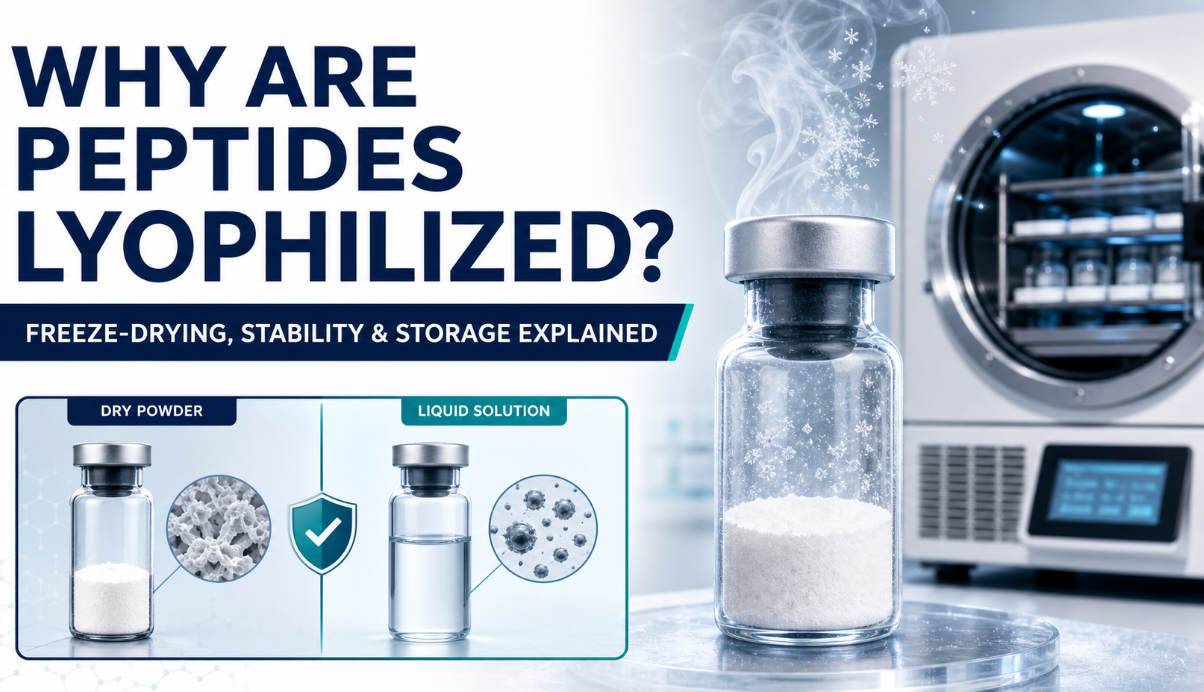
Peptides are lyophilized because removing most of the water can make them more stable during storage and transport than the same material held in an aqueous solution. Lyophilization, commonly called freeze-drying, freezes a peptide formulation and then removes ice by sublimation under reduced pressure. The process leaves a dry, porous solid that can limit molecular mobility and slow many water-dependent degradation pathways.
Freeze-drying does not make a peptide indestructible. Residual moisture, oxygen, light, temperature, the amino-acid sequence, container closure, and formulation ingredients can still affect stability. A good-looking white cake is useful physical evidence, but it is not a substitute for batch-specific identity, purity, content, moisture, and stability testing.
explore peptide stability resources
What Does Lyophilized Mean?
A lyophilized peptide is a peptide preparation that has been frozen and dried under vacuum. Instead of melting the frozen water and boiling it away, the process encourages ice to move directly from the solid phase to vapor. That phase change is called sublimation. The remaining material is usually a light cake, puck, film, or powder inside a sealed vial.
The word lyophilized describes the physical processing method, not a purity grade. A lyophilized vial may contain the peptide plus buffers, salts, bulking agents, or protective excipients. Those components may be intentional and can help the product survive freezing and drying. This is one reason the total mass of visible powder should not be assumed to equal the net mass of peptide.
Why Peptides Are Often Supplied as Freeze-Dried Powder
| Reason | How lyophilization helps | Important limitation |
| Chemical stability | Reduces available water and molecular mobility that support degradation reactions | Oxidation and other solid-state changes can still occur |
| Physical stability | Can preserve a manageable solid form during storage and shipment | Cake appearance alone does not prove molecular integrity |
| Flexible preparation | Lets a laboratory prepare the needed concentration at the time of an experiment | Solubility and compatible solvent still depend on the sequence and formulation |
| Transport | A sealed dry form is generally less vulnerable than an aqueous solution | Heat, humidity, light, and closure integrity still matter |
| Batch control | Supports fill-and-dry production in individual containers | Uniformity and content must be established analytically |
How the Lyophilization Process Works
- Formulation and filling. The peptide is prepared in a defined solution, sometimes with buffers, salts, bulking agents, cryoprotectants, or lyoprotectants. A controlled volume is filled into each container. Formulation matters because pH, ionic strength, concentration, and excipients can influence freezing behavior and the finished cake.
- Freezing. The filled containers are cooled until water forms ice and the remaining solutes become concentrated in the unfrozen phase. Ice-crystal size affects the pore structure left behind. Cooling rate, nucleation, and the formulation’s thermal properties therefore influence drying time and cake quality.
- Primary drying. Chamber pressure is reduced and controlled heat is supplied so ice sublimes. The product temperature must remain within a suitable range; excessive heat can cause collapse or loss of structure, while insufficient energy makes drying inefficient.
- Secondary drying. After visible ice is removed, additional drying reduces water that remains adsorbed to the solid matrix. The target residual-moisture level is product-specific. Lower is not always automatically better, because some formulations require a controlled amount of water to maintain their intended structure.
- Stoppering and sealing. Vials are commonly closed under controlled conditions, sometimes under vacuum or an inert gas. The stopper and seal help protect the dry material from moisture and oxygen. Container-closure integrity is therefore part of the stability system, not merely packaging.
Why Peptides Can Be Less Stable in Solution
Water allows molecules to move and react. Once a peptide is in solution, hydrolysis, deamidation, oxidation, isomerization, aggregation, adsorption to surfaces, and other changes may proceed more readily. The dominant pathway depends on the sequence, pH, temperature, buffer, oxygen exposure, concentration, light, and trace contaminants.
Lyophilization slows many of these processes by removing bulk water and reducing mobility. It does not erase the peptide’s intrinsic weak points. Methionine and cysteine residues can be vulnerable to oxidation; asparagine and glutamine can undergo deamidation; and some sequences may aggregate or form related impurities. Stability must therefore be demonstrated for the exact formulation rather than inferred from the word lyophilized.
Lyophilized Peptides vs Peptides in Solution
| Feature | Lyophilized form | Solution form |
| Water availability | Most bulk water has been removed | Water is present and supports greater molecular mobility |
| Typical stability profile | Often more stable when sealed and stored under validated conditions | Often more sensitive to time, temperature, pH, oxygen, and contamination |
| Handling concern | Moisture ingress, heat, light, and closure damage | Repeated handling, adsorption, oxidation, microbial growth, and freeze-thaw stress |
| Visual check | Cake, puck, film, or powder may be visible | Clarity, color, particulates, and precipitation may be observed |
| Evidence required | Identity, purity, content, moisture, and stability data | Identity, purity, concentration, stability, and appropriate microbiological data |
What a Lyophilized Peptide Cake Should Look Like
A well-formed cake is often uniform and porous, with a white or off-white appearance when that matches the product specification. Some formulations form a compact puck, others create a thin film, and some produce a loose powder. The acceptable appearance must be defined for the specific product; there is no universal cake shape that proves quality.
- Cake collapse can indicate that the product exceeded a critical temperature during drying, but appearance alone cannot quantify degradation.
- Shrinkage or pull-away from the vial wall may reflect formulation or process behavior and should be compared with the product specification.
- A broken cake can result from shipping vibration and does not automatically mean the peptide is chemically damaged.
- Visible moisture, discoloration, an unsealed stopper, or unexplained particles warrant further investigation.
The central rule is simple: cake appearance is a screening observation, not an identity or purity assay. HPLC, mass spectrometry, water-content testing, and stability-indicating methods provide information that a photograph cannot.
Does Lyophilization Guarantee a Long Shelf Life?
No. Shelf life is assigned from stability data generated for the specific peptide, formulation, container, closure, and storage condition. A different sequence, salt form, excipient system, or stopper can produce a different result. Broad statements that all freeze-dried peptides last for the same number of months or years are not scientifically reliable.
Long-term and accelerated studies commonly monitor identity, purity, related substances, appearance, residual moisture, content, reconstitution behavior, and other product-specific attributes. The correct storage condition is the one supported by those data and stated by the qualified supplier or manufacturer.
The Role of Moisture, Oxygen, Light, and Temperature
Moisture
Residual water can plasticize the solid matrix, increase molecular mobility, and speed degradation. Moisture entering through a compromised closure can also change cake appearance. Water-content methods such as Karl Fischer analysis provide more useful evidence than simply looking at the vial.
Oxygen
Oxygen in the headspace or entering through packaging can contribute to oxidation. Formulation antioxidants, inert-gas headspace, light protection, and suitable closure systems may be used when supported by development data.
Light
Some peptides or formulation components are photosensitive. Protective cartons, amber glass, or controlled lighting can reduce exposure. A clear vial does not prove that light protection is unnecessary.
Temperature
Lower temperatures generally slow chemical reactions, but the correct range remains product-specific. Temperature excursions, repeated warming, and condensation can matter even when the material is dry. A vial should be allowed to reach the relevant controlled handling temperature before opening when condensation is a concern.
Why the Powder May Contain More Than Peptide
Lyophilized products may include mannitol, sucrose, trehalose, glycine, buffers, or other excipients. Bulking agents can create a robust cake when the peptide mass alone would be too small to form a visible structure. Stabilizers can help protect against freezing and drying stresses. Buffers control pH after the material returns to solution.
These ingredients are not automatically impurities. They should be identified in the formulation record and considered when interpreting total powder mass. A 10-milligram peptide claim should be supported by a quantitative content or assay result, not by weighing the complete cake.
How to Evaluate a Lyophilized Peptide COA
- Match the peptide name, form, sample ID, and lot number to the vial.
- Confirm identity with appropriate evidence such as mass spectrometry.
- Review the complete HPLC or UPLC chromatogram rather than only a purity percentage.
- Look for a separate quantitative assay when net peptide content matters.
- Check whether residual moisture and appearance specifications are reported.
- Confirm the laboratory and report identifier independently.
- Do not treat chemical purity as proof of sterility, endotoxin status, or human-use suitability.
Frequently Asked Questions
Is lyophilized the same as powdered?
Lyophilized material is dry and may look powdery, but the term identifies a specific freeze-drying process. A generic powder may have been produced by another drying or manufacturing method.
Does a broken peptide cake mean it is ruined?
Not necessarily. Mechanical shock can fracture a cake without changing the peptide’s chemical identity. However, visible damage cannot rule out a temperature excursion, moisture problem, or closure failure. Batch records and analytical testing provide the stronger answer.
Why can two vials look different?
Differences in fill volume, solute concentration, freezing behavior, nucleation, drying conditions, excipients, and shipping can alter cake appearance. Meaningful variation should be evaluated against validated process limits and finished-product specifications.
Is a lyophilized peptide automatically sterile?
No. Freeze-drying is not a substitute for a validated sterilization or aseptic manufacturing process. Sterility and endotoxin claims require separate, appropriate evidence.
Final Takeaway
Peptides are lyophilized primarily to improve stability by removing water and reducing molecular mobility. The process can make storage, transport, and laboratory preparation more practical, but its benefits depend on the peptide sequence, formulation, drying cycle, residual moisture, packaging, and storage conditions.
The dry cake is only one part of the quality picture. Reliable evaluation still requires a batch-specific certificate, identity and purity data, quantitative content testing when relevant, and stability evidence for the exact product. Lyophilized should be read as a manufacturing description, not a promise that the material is pure, sterile, safe, or indefinitely stable.